Here are some shots from the birdfeeder in the backyard. I had my camera outside because an oriole was showing up to J's orange/jelly feeder and they usually don't stick around very long.
Some of the below shots show "frozen" motion of birds, and I picked the best ones that were in focus. Next time I may try to get closer to the feeder, although doing that scares the birds off.
I used the manual focus on my camera plus the burst mode, in which the camera takes 10 shots per second. Burst mode, plus a very fast shutter speed (1/2000 second) can help capture movement and sometimes get some fun shots. I sat in a chair on the patio, about 15 feet away from the feeder. My hope here was to use the camera settings to capture birds flying in to, or away from, the feeders.
For Christmas, J got me a set of three boat/ship models. They are designed to be progressively difficult, with the first being the "beginner" model. I'm 5 weeks into building it, and I'm still not done. It may be a beginner model, but I wouldn't classify it as easy.
Here's a picture of what mine looks like at the moment. It's about 3/4 done.
Fear of Heights
Why anyone would want to go to some deadly high place is beyond me. Take these stories, for example...
A Floating Retreat in the mountains. Nothing says vacation and relaxation like lying awake, shaking with the overwhelming anxiety that you're about to plunge to your death. I'm sure they double-check the ropes once a year to make sure they're secure, though.
Japanese Vending Machines
I had a coworker who once told me about a vending machine he ran into that made french fries. The Japanese are known for their fun and quirky vending machines. Here are a few YouTube videos about that topic. I like the one that has the mystery packages .
Guitar great Jeff Beck passed away recently, which sent me to Qobuz, the music service I subscribe to, to listen to some of his music. I used to own some records back in the day.
Play Chronophoto and guess what year a photo was taken. I guessed a few right, and was close on a few others, but I whiffed on a lot of them.
I like to play Name Drop on the New Yorker website. They give you clues about a person and you have to guess who it is. The trick to knowing the answers is to have read and memorized details from all the articles in the New Yorker about people from the last 10-15 years, because the facts usually come from those articles.
Keep Movin'
To close, I wish I could move like this, or even keep my balance as well as this guy.
In my last post, I linked to the work of other photographers who were using focus stacking to show the magnified details of various objects that aren't normally visible to the naked eye. One image that I liked was the penny with popcorn salt on it. (Original thread with photographer credit; image)
I did my own version of this and here's the result. I don't have the microscope objective that the other photographer used, so I can't get as close up, but I wanted to see how much magnification I could get out of my camera, lens, and lens accessories.
Equipment used: Camera: Olympus E-M1 Mark II
Lens: Olympus 60mm f/2.8 macro lens
Extension Tubes: Meike 10mm + 16mm (similar to these)
Magnifying Lens: Raynox DCR-150 attached to lens with step-down rings
Tripod: Crummy one but it worked
The extension tubes extend the lens, giving a magnification side-effect, and the Raynox is basically a magnifying glass at the end of the lens. With the high magnification, the depth of focus was even smaller than the previous example I showed.
Here's a shot from the middle of the stack.
Here's the final image from the stacking software - it's 97 shots stacked. Did you know salt was cubular? I didn't.
Before I took this series of photos, I tried a set with a penny with popcorn salt on it, like the original I'm trying to duplicate. That set of shots didn't turn out well because I bumped the table and moved the penny, but I learned that popcorn salt is actually shaped like tiny popped kernels! (Not really. It's cubes, too.)
I was recently talking to my sister about photography and I brought up the topic of focus stacking. It's hard to explain, so here's a demonstration.
Magnifying for Macro
The world of macro photography is fun - the more space on your camera's sensor you can take up with the image you want to capture, the more detail you can see on your subject. Normal zoom lenses can often do some macro-type work; some are designed to allow you to be close to your subject and still allow the lens to focus. Most typical zooms can't - you have to stand back from your subject in order for the camera to be able to focus.
With specially-designed macro lenses, you can get up close to your subject and magnify it such that details will show up in your images that you could never see with your naked eye.
Focus Stacking Example
Here's a picture of my macro photography setup:
Camera: Olympus E-M1 Mark II
Lens: Olympus 60mm f/2.8 macro lens
Tripod: Super cheap old tripod from Best Buy that came free with a camcorder, circa 2003.
Software: Olympus Capture.
Here is a shot of the subjects with normal camera settings - a bolt, Red Cross donor pin, and the ruler portion of steel calipers. The dark base they're on is an old tablet computer.
Olympus Capture
This software allows me to plug the camera into the computer and operate the camera through the software, instead of making changes on the camera itself. Here's a screen snapshot of the application running.
Most of the options shown on the right side would normally be changed on the camera itself, but they can be changed here. On the bottom right are some chevrons (<<<, <<, < and >, >>, >>>) which can be used to tell the camera to zoom in or out a little or a lot at a time. This is the equivalent of my rotating the focus ring on the lens by hand. I use these during the process of taking all the shots that will eventually be stacked.
Getting Started
I started off by focusing the lens on the closest point to the camera and taking a picture. Note how little of the image is in focus (where the arrows are pointing).
The problem with macro lenses, and microscope lenses (objectives) for those who use them, is that magnifying at this level means that not much of your shot will be in focus. It has to do with the physics of light and the way the lens and camera process it. The "depth" of the in-focus portion of the image is referred to as Depth of Field, or Depth of Focus. As you can see, with this lens and camera set up the way they are, there is a very shallow depth of field. Here's a good explanation, if you're interested.
Because it would be great to get a clear, highly-magnified view of this scene, I can't just set my lens at its highest magnification and take a picture, because the depth of focus is so shallow that I'll only get a little bit of the image in focus. This is where focus stacking comes in - stacking involves taking a picture, refocusing the lens to be slightly farther away from the camera, taking another picture, then repeating these steps until the lens is focusing on the very back of the scene, or the lens isn't capable of focusing any father away.
Each of these shots will include small slices that are in focus, and the rest will be out of focus. The "stacking" part is done by software, which can identify which parts of which image is in focus, and combine those in-focus parts with the other in-focus parts of the other images, and then combine them. (How does it do that? I have a vague idea but it's mostly magic.)
Moving the Focus Across the Subject
Let's continue to watch the focus change through the images as the focus is "moved away" from the camera and towards the back of the subjects.
This photo is about half-way through the focus's travels. The parts in focus are indicated. The parts of the first shot above that were in focus are now completely blurry.
The next photo is about 3/4 of the way through. Note that the focus is "moving" towards the back. Anything at a particular distance from the lens is in focus, even if the different objects in the picture are above or below each other.
Here is the final shot; only the very farthest reach of the subject is in focus.
Stacking the Images
Now that we have these shots, we can load them into Zerene Stacker or Adobe Photoshop to be stacked. The image below was created by Zerene Stacker, which is named for the one thing it does really well (and better than Photoshop): focus stacking.
The in-focus parts of each image were "found" by the software and included into the resulting image. You can see all the little imperfections of the steel in the bolt, the tiny marks on the face of the Red Cross pin, and the other flaws that are not visible without magnification.
Watching the Focus Move
I made a short video showing the progression of the focus - there are about 40 images total. This helps visualize the different steps.
Stacking Non-macro shots
It's possible to stack non-macro shots. It can be done with landscape photography, product photography for advertisements, and many other place - anywhere you can use a tripod to control the framing of the image you're taking. The idea is the same - the in-focus parts of the images you stack will be blended with the others.
More Examples of Macro and Stacked Images
Here are a few links to stacked and macro images on the Photomacrography website, where amateurs and professionals alike gather to show off their work, learn from others, and trade ideas. Some of these images were made with microscope objectives, which exhibit a tiny depth of field as a tradeoff for the high magnification they provide.
Dissolving sutures macro shots. This page not only discusses the appearance of real-life sutures, but makes a conjecture about how they are tied by a surgeon. Then a surgeon who is also a photographer weighs in, and the photographer eventually presents the images to the surgeon who performed the operation. Photography, knots, surgery - all in one place!
Popcorn salt on top of a penny, 330 shots in a stack. Neat! Click here for the discussion, and here for the picture.
Robber fly parts, a few different stacks are shown. I believe this was done with a microscope objective, attached to the camera with other lenses or adapters.
This is a small sample of what's on the forums, you can look around there to see other images of very small things, see people's setups, and so on.
Dad didn't talk much about his service, but I remember his saying he'd finished first in his class in Engineer School in Eta Jima, Japan.
NFL Prognostication
Going into today’s game, the L.A. Rams are 13-5. If they
beat the Tampa Bay Bucs, they’ll be in the conference final. Matthew Stafford is
finally getting the season he’s waited for. On the other hand, never bet against
Tom Brady, no matter how old he gets. My prediction: The Rams' Aaron Donald sacks Tom Brady with a clean hit, Brady is injured, and Matthew
Stafford is traded to the Bucs at halftime, leading them to a win and an
eventual Super Bowl title, while Aaron Donald and the rest of the Rams wonder what the heck just happened.
Fun Stuff
Atlas Obscura has a fun website that celebrates unique and
unusual locations all over the globe. Here’s their list of such sites in Michigan.
Time for a road trip!
My dad had a Smothers Brothers album with this song on it, which I thought was hilarious. The lead-up to the song is brilliant. Interestingly, it looks to me like Shel Silverstein wrote it, but it's hard to tell for sure.
Porch Sittin'
1976, on the porch at S. Grinnell St.
At the time this picture was taken, it’s unlikely my brother
had ever played soccer (no kids in Jackson really did back then), and I had not seen the 1976 Dino De Laurentis remake of “King Kong”. I still haven’t seen it. I think it was about a large ape who sets
out from his homeland, seeking adventure with his tiny human wife while he pursues a career in New York City real estate.
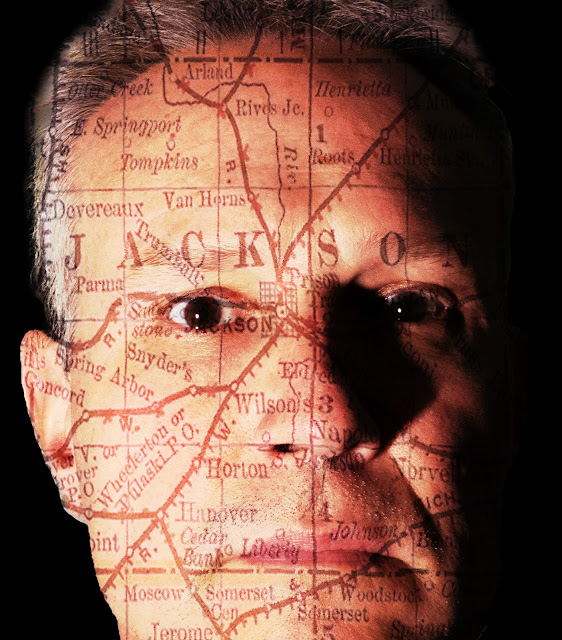
This picture was created by taking a photo of a negative and using Photoshop to, er, un-negative the image into what's above. There was some damage to the negative which is visible on my forehead. My very crude setup for taking pictures of negatives was OK for a few frames, but it was slow. If I were to want to scan a lot of negatives, I'd buy a device like this instead of doing it with a camera.
After taking the photo of the negative (resting on a piece of glass with a desk lamp behind it), and cropping it.
Using the "tiny planet" idea, here's a part of a circuit board that has been spun around. I like to imagine the pointy ends of the components in this image could all shoot a laser at once and produce a Death Star-like ray of destruction. Or toast a marshmallow.
Parts of two different Argus cameras, both made in Ann Arbor, MI, USA
This photo is my cluttered and humble entry in a local camera shop's macro photography contest. I tried a number of different shots and angles and lights and I submitted this one. My primary motivation for making a decision about what shot to enter was the contest's August 31st entry deadline.
Read a little more about the Argus Camera company here. When they were still operating, they donated the planetarium inside Pioneer High School, which the Washtenaw Elementary Science Olympiad uses on tournament day for the "To Infinity and Beyond" astronomy event.
At Lillie Park South in Ann Arbor, I took the new camera out for a walk. I met some runners on the paths, mosquitos nibbled on my elbow, and I met a bird that I could not identify. Soon after the original post here, bird lovers J and Amy both identified it as a green heron.
Based on the picture above, I'd bet this bird was in a marching band. Upright posture, ankle properly flexed, eyes forward. All it's missing is an instrument.
A green heron getting some sun.
I'm out of here...
Twigs everywhere and the roof is leaking. This is why birds can't have nice things.
A Sandhill Crane. I don't know if it's a boy or girl, and I'm not about to look.
There is a pair of cranes that lives in the farmland/wetlands near my Ann Arbor office. They wander around all day, and they're not afraid of people. I always give them plenty of room, though, because of those long, pointy beaks. Besides being good for catching fish and toasting marshmallows, they could also do some damage to my soft tissue.
Here is my so-so take on a classic Photoshop standard project. There are lots of fun variations on this, many including a large picture frame in an outdoor setting. I don't have a large picture frame around, so we'll go with the desktop version.
There weren't actually this many birds at once under the feeder. This is a composite of about 30 photos taken from a camera on a tripod. I was inside the house pressing a button on my phone, telling the camera to take a shot when a bird was in view. The phone and the camera communicate over wi-fi.
I need to try this at a different time of day when other birds and animals are around - some cardinals or blue jays would really bring some color to this. And squirrels, chipmunks, beavers, turkeys, raccoons, and red squirrels would add some variety.
At work, we use Microsoft Teams for our video conference calls. Calls on Teams are similar to Zoom. One feature of Teams and Zoom is the ability to insert your own background, so it looks as if you're in a different building, or on a tropical island, or somewhere else.
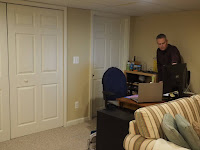
I took three pictures of myself in different shirts and positions in my basement, and combined them into one image where the three of "me" are either getting things done or taking a break.
In spring of 2020, I stepped down from the Board of Directors for Washtenaw Elementary Science Olympiad (WESO). I had been a member for about five years. I "retired" a little before the end of April - I was planning to leave after our May tournament, but COVID-19 caused us to cancel it.
I had promised myself that I was going to spend some time learning Lightroom and Photoshop in my post-WESO life. Many photographers learn and use both to enhance their images.
Over the course of the year, I took several online training classes, and the boys bought me a "how to restore old photos" book for Father's Day. Below are some of the projects I worked on.
The Home Office "Hamilton" Poster
I imagine this is what the poster would look like if Lin-Manuel Miranda had written a musical about cats, dogs, and using your own bathroom during work hours.
Home Office: An American Musical
The Tiny Planet of Don's Dwellings
This is a "tiny planet" with an image of each of the buildings/homes/apartments I've lived in. I started with an image of each house laid out horizontally (and stretched really tall) then put in some trees and the grass. [Edit: I found the horizontal image and added it below.] That was followed by the clouds and the "Home" in the middle. The special ingredient is love.
Tiny Planet of places I've lived
What the houses looked like before the rotation.
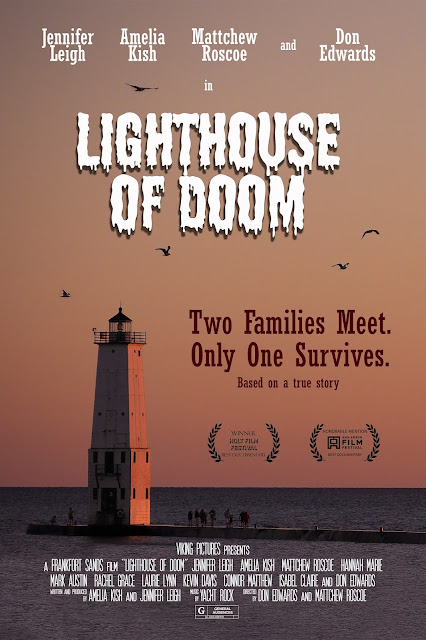
Frankfort, Michigan Movie Poster
This is a tribute to the many years we've met our friends The Baroskos at Frankfort, MI for a beach vacation. The names are all either first/middle names of family members, or plays on names, or nicknames. Look closely and you'll see a reference to Sirius radio stations, and our hometown of Jackson. The title and tag line of the "movie" were suggested by Hannah.
A Tribute to Pioneer High School's Marching Band
M is no longer at the high school, but when one of the parents with children there asked if I could put together something similar to the home tiny planet for the band, I couldn't resist. I was looking for Photoshop projects, and this was a good idea. Getting the symmetry right was a bit of work, but it was fun to go back through all of M's and K's high school pictures to find the ones that were used here.
Pioneer Marching Band poster
Soon there will be another post with restorations of some of dad's pictures when he was in the Marines. Stay tuned.