---
I just finished Tinkers by Paul Harding. A story about a dying man and his memories of growing up, it won a Pulitzer Prize. The book got off to a slow start, and started to intermingle the present day and flashbacks, and I wasn't following it too closely. The man was a clock repairman by trade, and there were some interesting comments about his profession, but the skipping around, which I believe was supposed to be a reflection of his mind's erratic focus, was hard to follow. Occasionally, some of the characters hallucinate, which is always a difficult literary maneuver. In one hallucination, a character sees an Indian next to a pond, and a fish jumps into his mouth. It is hard to make the transition from the occasional straight-line storytelling to a hallucination/daydream/flashback to the eventual return to reality.
I wasn't sure how much farther I was going to go with it when the story shifted to a long reminiscence about his childhood, and for about one hundred pages I had a hard time putting it down, as they say. The father of the aforementioned dying man, a traveling salesman of brushes and soap, had difficulty being a great father, and had epilepsy before they knew what that was. The man and his wife managed to keep the seizures a secret from their children, until one day at dinner the father had a seizure in front of the family. The portion of the book that narrated the father's story was very well-done, and I really felt what was happening in the book - the reaction of the family members, the fear and panic of those who had not yet witnessed a seizure, and the believable calm of the wife.
After the story of the father winds down, the book returned to the present day, and almost immediately, the flow of the book (and my understanding of which time period was being covered) became choppy again.
I give it four out of five stars, with a solid five stars for the middle 100 pages.
I've read several non-fiction books lately, mostly having to do with computer languages like JavaScript and Python. I'm not sure what I'm going to do with that information, but JavaScript has been on the minds of quite a few people at my work lately as a language that some of us may be getting more familiar with in the weeks and months to come.
---
K is reading Middleworld, about a boy whose archeologist parents go to Central America. He is invited to join them there, but finds they've disappeared.
M is reading The Twenty-One Balloons, a Newberry Medal-winning book he read last year and wanted to read again. I think I might like to read this one.
J is finishing up the latest Diary of a Wimpy Kid book, a series we've all read and enjoyed. The writing is a mix of comics and words, and is the diary (although he doesn't like to call it that) of a boy who is struggling with his identity in a world of wierd friends, bullying brothers, and icky (but somehow fascinating) girls. And, of course, his experiences with The Cheese Touch. I'm not sure what other books she's read lately, but she always has one in progress.
Everyone here except me has read The Hunger Games, and after hearing what it's about, I'm not sure I can stomach it. We'll see.
---
We finally bought a new camera to replace our aging Canon A510. We bought a Panasonic Lumix, partly because it was recommended by my dad, and partly because we were having a hard time finding a different, smaller camera with similar features. We're happy with our choice, and we've already taken quite a few pictures.
---
Thanksgiving is near! We're going to see almost all of our family, most of whom are conveniently located in the state of Michigan. We're looking forward to the fun and food, and the opportunity to see some relatives we usually only see this time of year.
Happy Thanksgiving!
---
Plane Rehab, Plus A Few Links

Planes (the woodworking kind, not the other kind)
Dad found a few planes at a thrift store and handed them off to me to see if I could do something with them (thanks, Dad!) I started with the most promising one, a Millers Falls model 14B, which is very similar to the more common Stanley #5 smoothing plane.
I took it apart, cleaned up the rust, polished the metal parts, stripped the red stain off the handles, and restained and them. After a few coats of clear finish, the handles (also known as the tote and the knob) were back on, and it was almost ready to go. A little honing on what was already a pretty sharp blade, and I was in business.
There are two more planes in the set, and I am not sure if one of them can be saved - it has a lot of rust on the sole. But I'll give it a try and see what I can do.
"Family" Fun Night
M and I went to his school's Family Fun Night last night from 6:00 - 8:00. It is so named because family members of students are invited. Whether the middle-schooler has any desire to actually spend time with his or her family at the Family Fun Night is an entirely different matter. When we got there, we bought a slice of pizza for dinner, and I asked M what the plan was. His answer: "I'll meet you at the front door at 7:55." OK, then. I wandered around, talked to some other parents, introduced myself to some volunteer moms and dads that I didn't know, talked to one of M's teachers, and played basketball with a few sixth-graders I know from Lawton. I'm not sure if I avoided embarrassing M by being there, you'll have to ask him.
Soccer season for K has ended. He had a good year, and scored a goal in a game a few weeks ago. His team played very well again this year, winning all but one game, and most of the wins were of the lopsided ilk.
Links
The only reason I wouldn't buy an Electric DeLorean is, well, actually, I guess if I had the money, I'd buy one. They're cool!
David Malki, creator of Wondermark, provides a brief but important flowchart for internet users.
Jim Gaffigan asks his friends who are so eager to spend their days off work camping and hiking: "If it's so great outside, why are all the bugs trying to get into my house?"
Providing tools and materials to people who need them, and teaching them how to use them, is better than standing around wondering why they're not being productive.
I read this book, Banker to the Poor, by Muhammad Yunus, several years ago. It's about microloans in developing countries, and its concepts can apply in countries like the US as well. The idea that loaning even ten or twenty dollars to someone in a developing country can help pull them out of poverty doesn't make much sense to us, but it's real, and it works.
---
Halloween
---
 M did the two end pumpkins, K did the castle, and I did the bubbling cauldron. The cauldron glowed with the light inside it, but it never quite looked like I hoped it would.
 K is a hobo, and M nerds it up big time with his headgear and brainiac hairdo.


Falling for October
Fall? Yes.
Fall is definitely here. The colors on the leaves are changing, there's a chill in the air, and there are only a few weeks left in soccer season. It's getting darker a lot earlier, and we find ourselves inside under blankets, keeping warm while we slow down our day. The Halloween decorations are up, and the pumpkins are on the porch, waiting for us to carve out their guts and cut holes in their skins. Gross.
J sometimes buys little bags of candy corn and pumpkin-shaped treats and puts them in a bowl on the counter. They're not as tasty as I remember from my childhood. It could be that I just enjoyed them more as a child, but it is probably because they now make them out of recycled newspapers and milk jugs. The way we recycle everything has really changed the food industry, hasn't it? I just read that my favorite pop, Diet Mountain Dew, is made entirely of water, caffeine, and grass clippings from golf courses.
What's going on at work for me? Nothing new, still working on the new product with a combination of Silverlight, C#, and SQL Server. Stop me if you've heard this one.
J and I went to the middle school teacher conferences last week. The teachers sit at tables in the cafeteria, and parents have a few minutes to talk to the teachers about the class and their student(s). M is doing very well in his classes so far, and has fit in well. He's playing soccer, and his practices are over for the season, with one game to go.
A Few Links
Scratch-built models:
Cannon model
Corsair airplane
A cat made from typewriter parts
The Missing Link
I found a link to the website that gave me the idea to put a new handle on my pocket knife, and I was wrong - the author used wood, not bone. I must have been thinking of another site...
Knife Project
---
Several years ago, I was given the opportunity to go through some of J's grandfather's tools and take the ones I would use. I regret that I didn't take more time to think through what I would like to have, and that I did not take more than a small box's worth of tools. I'll put that day on my time travel wish list. I was fortunate to grab some very nice things, many of which I have used on one project or another, and they are a reminder of him and the wonderful work he did in his woodshop when he was alive.
One of the items I took was an old pocket knife. It has three blades, a long clip-point, a short clip-point, and a short sheepsfoot blade, which is often used for whittling. (See Wikipedia for the definitions of the blade shapes.)
One side of the knife was bone, and the other was black plastic. The bone side was crumbling, and had been cracked since I acquired it.
 This knife could use some work, although I have used it for several years, and the blades have always done their jobs.
I saw a website where someone shared his experience with removing the sides of his pocket knife and replacing them with bone. I can't find the article or I would put a link to it here. It gave me the idea to replace my knife's sides, although I didn't want to bother with bone.
I thought it would be pretty easy to make some wood replacements for the sides. I removed the material, then took out a bit of cherry and sawed, filed, sanded, and otherwise shaped the sides to fit. It was not as easy as I thought, partly because holding down such small pieces of wood was a challenge. I don't have any bench sanding tools that were appropriate for this project, so it was largely a matter of time and patience.
 Some pieces in various stages of being shaped. I made several sides before I got two I liked.
While the old sides were off, I cleaned the blades and sharpened them, using 600-1000 grit sandpaper, and then honed them on a strop. They were already pretty sharp from a prior sharpening session a few years ago, but this was a good opportunity to do it again. I have used the knife quite a bit, despite its failing appearance.
When the sides were finished, they looked a little odd - most knives have rivets to hold the side materials in place, and I didn't have any rivets or tools to insert them. The plain wood didn't look quite right.
I decided to add fake "rivets" to the sides to give them a more traditional look. I bought some brass rod at the hardware store and cut it into small pieces, then filed and sanded the pieces until they were slightly rounded at the ends and short enough to fit into the wood sides. I drilled holes in the sides using a pin vise and a small bit, then I superglued the brass into the holes. I let the glue set for a day, then superglued the sides onto the bare metal of the knife. The super glue I used was the gel kind, not the liquid kind. The gel kind will fill gaps and is more forgiving when the two mating parts are not perfect fits.
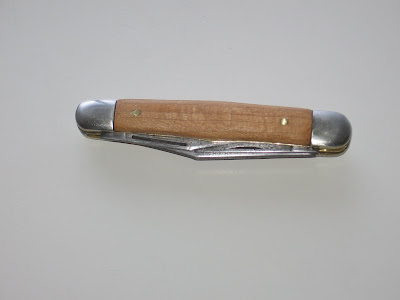
Here is the result. A successful project, and it wasn't too hard. I did make a mistake on the side you're not seeing which caused a tiny hole to appear as I was doing my final sanding and shaping. I can live with that, though, because I wasn't creating a museum piece and the knife is working very well, hole or no hole.
 Ready to go
---
Stay tuned for more tool restorations at The DEB Log. I have another tool on the bench, this one from my dad, and I hope to have it cleaned up and ready to go soon.
Also, Halloween is coming, and I've been putting some thought into my pumpkin design this year. The UM fans around the neighborhood are tired of seeing my MSU pumpkins, so I'll give them a break and move onto something different.
---

Several years ago, I was given the opportunity to go through some of J's grandfather's tools and take the ones I would use. I regret that I didn't take more time to think through what I would like to have, and that I did not take more than a small box's worth of tools. I'll put that day on my time travel wish list. I was fortunate to grab some very nice things, many of which I have used on one project or another, and they are a reminder of him and the wonderful work he did in his woodshop when he was alive.
One of the items I took was an old pocket knife. It has three blades, a long clip-point, a short clip-point, and a short sheepsfoot blade, which is often used for whittling. (See Wikipedia for the definitions of the blade shapes.)
One side of the knife was bone, and the other was black plastic. The bone side was crumbling, and had been cracked since I acquired it.

I saw a website where someone shared his experience with removing the sides of his pocket knife and replacing them with bone. I can't find the article or I would put a link to it here. It gave me the idea to replace my knife's sides, although I didn't want to bother with bone.
I thought it would be pretty easy to make some wood replacements for the sides. I removed the material, then took out a bit of cherry and sawed, filed, sanded, and otherwise shaped the sides to fit. It was not as easy as I thought, partly because holding down such small pieces of wood was a challenge. I don't have any bench sanding tools that were appropriate for this project, so it was largely a matter of time and patience.

While the old sides were off, I cleaned the blades and sharpened them, using 600-1000 grit sandpaper, and then honed them on a strop. They were already pretty sharp from a prior sharpening session a few years ago, but this was a good opportunity to do it again. I have used the knife quite a bit, despite its failing appearance.
When the sides were finished, they looked a little odd - most knives have rivets to hold the side materials in place, and I didn't have any rivets or tools to insert them. The plain wood didn't look quite right.
I decided to add fake "rivets" to the sides to give them a more traditional look. I bought some brass rod at the hardware store and cut it into small pieces, then filed and sanded the pieces until they were slightly rounded at the ends and short enough to fit into the wood sides. I drilled holes in the sides using a pin vise and a small bit, then I superglued the brass into the holes. I let the glue set for a day, then superglued the sides onto the bare metal of the knife. The super glue I used was the gel kind, not the liquid kind. The gel kind will fill gaps and is more forgiving when the two mating parts are not perfect fits.
Here is the result. A successful project, and it wasn't too hard. I did make a mistake on the side you're not seeing which caused a tiny hole to appear as I was doing my final sanding and shaping. I can live with that, though, because I wasn't creating a museum piece and the knife is working very well, hole or no hole.

---
Stay tuned for more tool restorations at The DEB Log. I have another tool on the bench, this one from my dad, and I hope to have it cleaned up and ready to go soon.
Also, Halloween is coming, and I've been putting some thought into my pumpkin design this year. The UM fans around the neighborhood are tired of seeing my MSU pumpkins, so I'll give them a break and move onto something different.
---
Greenfield Village in Pictures
---
Click on any of the pictures to see a larger version.
---
All you old-timer computer guys who brag about using punch cards should see the loom that used punch cards long before that...

For more info, see this page on the Jacquard loom.

K showed the Greenfield Village employee how to operate the 1917 Brown & Sharpe Turret Lathe to make a small candlestick holder.
This blurry video shows it in action. If you'd like to own one, I saw a few for sale when I was Googling around...
 After K taught the guy how to run it, I gave it a spin, so to speak. In this picture, the employee appears to have some doubts about my abilities.
 I wish I had a better picture of this machinist's chest, but I couldn't get close enough. Someday I'm going to make a scaled down version of this.
 For all you woodworkers who obsess over things "lining up" and "looking nice", this piece of shop storage is functional, and the drawers move in and out as expected. That's all you need.
 This lathe, seen here in the Village's roundhouse, is used to create parts for repair of steam locomotives. After hours, it is leased to a local matchstick factory.
 Sure, they've got a lot of wrenches, but can they change my bike tire?
 One of your larger reciprocating saws, as seen in the sawmill. This sawmill isn't operational, which is too bad, because I would really liked to have seen this in action.
---
Click on any of the pictures to see a larger version.
---
All you old-timer computer guys who brag about using punch cards should see the loom that used punch cards long before that...

For more info, see this page on the Jacquard loom.

K showed the Greenfield Village employee how to operate the 1917 Brown & Sharpe Turret Lathe to make a small candlestick holder.
This blurry video shows it in action. If you'd like to own one, I saw a few for sale when I was Googling around...


---
Wolverine's Lair Wand Company: Back in Business

For several weeks, I worked on this wand, and wooden storage box, for a good friend of K's. She is in his grade, and lives across the street. She has the same love for Harry Potter and spell-casting as K, so the Wolverine's Lair leadership decided to resume production for a custom wand.
The wand was carved with a single knife out of basswood. It was shaped with a pullknife, a file, a card scraper, and the knife.
The box has finger joints and is made of poplar. It is lined with soft, red fabric and has a pillow that allows the magic to rest comfortably when it has a chance.

---
Subscribe to:
Posts (Atom)